Mission Info
Chandrayaan-2 mission is a highly complex mission, which represents a significant technological leap compared to the previous missions of ISRO. It comprised an Orbiter, Lander and Rover to explore the unexplored South Pole of the Moon. The mission is designed to expand the lunar scientific knowledge through detailed study of topography, seismography, mineral identification and distribution, surface chemical composition, thermo-physical characteristics of top soil and composition of the tenuous lunar atmosphere, leading to a new understanding of the origin and evolution of the Moon.
After the injection of Chandrayaan-2, a series of maneuvers were carried out to raise its orbit and on August 14, 2019, following Trans Lunar Insertion (TLI) maneuver, the spacecraft escaped from orbiting the earth and followed a path that took it to the vicinity of the Moon. On August 20, 2019, Chandrayaan-2 was successfully inserted into lunar orbit. While orbiting the moon in a 100 km lunar polar orbit, on September 02, 2019, Vikram Lander was separated from the Orbiter in preparation for landing. Subsequently, two de-orbit maneuvers were performed on Vikram Lander so as to change its orbit and begin circling the moon in a 100 km x 35 km orbit. Vikram Lander descent was as planned and normal performance was observed upto an altitude of 2.1 km. Subsequently communication from lander to the ground stations was lost.
The Orbiter placed in its intended orbit around the Moon will enrich our understanding of the moon’s evolution and mapping of the minerals and water molecules in Polar regions, using its eight state-of-the-art scientific instruments. The Orbiter camera is the highest resolution camera (0.3 m) in any lunar mission so far and will provide high resolution images which will be immensely useful to the global scientific community. The precise launch and mission management has ensured a long life of almost seven years instead of the planned one year.
Science experiments
Chandrayaan-2 has several science payloads to expand the lunar scientific knowledge through detailed study of topography, seismography, mineral identification and distribution, surface chemical composition, thermo-physical characteristics of top soil and composition of the tenuous lunar atmosphere, leading to a new understanding of the origin and evolution of the Moon.
The Orbiter payloads will conduct remote-sensing observations from a 100 km orbit while the Lander and Rover payloads will perform in-situ measurements near the landing site.
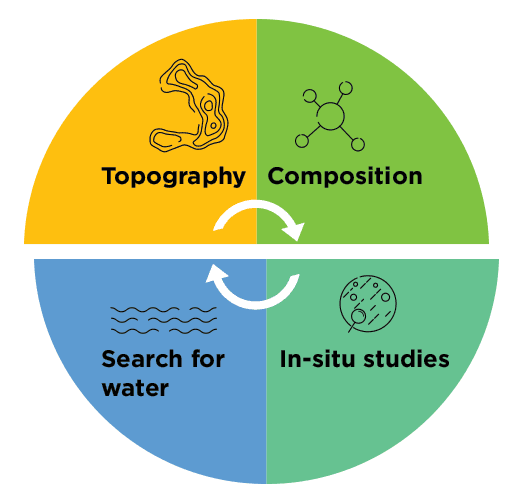
For understanding of the Lunar composition, it is planned to identify the elements and mapping its distribution on the lunar surface both at global and In-situ level. In addition detailed 3 dimensional mapping of the lunar regolith will be done. Measurements on the near surface plasma environment and electron density in the Lunar ionosphere will be studied. Thermo-physical property of the lunar surface and seismic activities will also be measured. Water molecule distribution will be studied using infra red spectroscopy, synthetic aperture radiometry & polarimetry as well as mass spectroscopy techniques.
Click here for a list of all payloads.
Key Payloads
| Chandrayaan 2 Large Area Soft X-ray Spectrometer | Elemental composition of the Moon |
| Imaging IR Spectrometer | Mineralogy mapping and water-ice confirmation |
| Synthetic Aperture Radar L & S Band | Polar-region mapping and sub-surface water-ice confirmation |
| Orbiter High Resolution Camera | High-resolution topography mapping |
| Chandra's Surface Thermo-physical Experiment | Thermal conductivity and temperature gradient |
| Alpha Particle X-ray Spectrometer and Laser Induced Breakdown Spectroscope | In-situ elemental analysis and abundance in the vicinity of landing site |
Chandrayaan 1 Legacy
- 15th August, 2003Chandrayaan programme is announced by Prime Minister Atal Bihari Vajpayee
- 22nd October, 2008Chandrayaan 1 takes off from the Satish Dhawan Space Centre at Sriharikota
- 8th November, 2008Chandrayaan 1 enters a Lunar Transfer Trajectory
- 14th November, 2008The Moon Impact Probe ejects from Chandrayaan 1 and crashes near the lunar South Pole — confirms presence of water molecules on Moon's surface
- 28th August, 2009End of Chandrayaan 1 programme